



ESPHome Starter Kit
BUILD. LEARN. AUTOMATE.
The easiest path to building your own smart home devices.


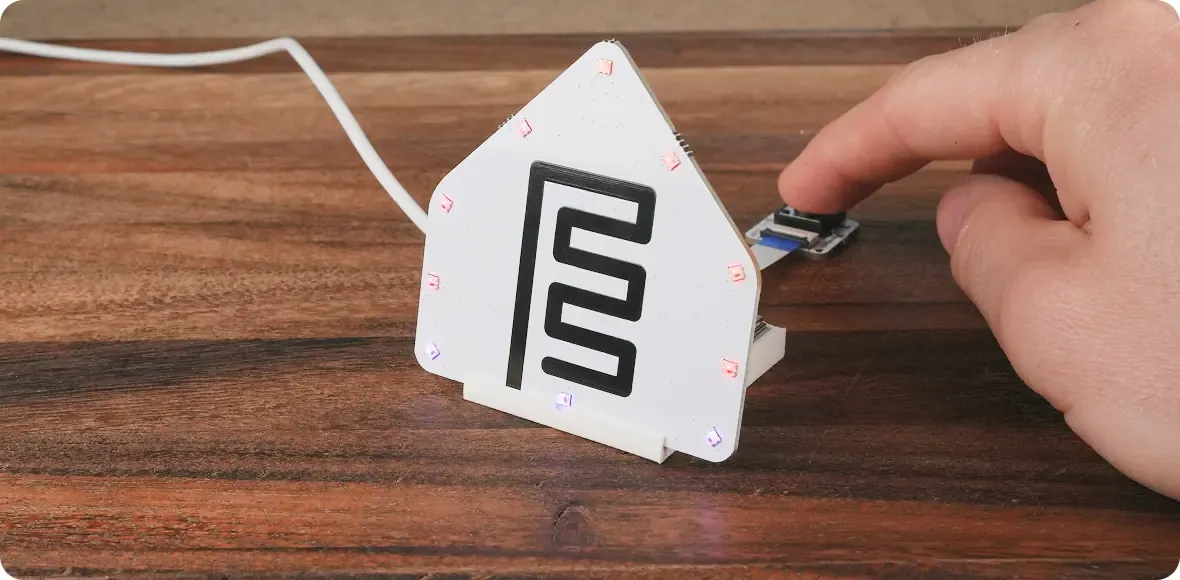
A physical, clickable button that triggers any smart home automation you set up, built for repeated everyday use.
Keep track of your home’s climate in real time and use that data to trigger automations to make your home more comfortable and energy efficient.
A reliable motion sensor that detects the heat given off by moving people and/or animals: one of the most practical and widely used sensors in home automation.
Programmable lights and a small buzzer give you visual and audio control over your automations: from subtle status indicators to attention-grabbing alerts.
The ESP32-C6 Board is a small-but-mighty chip that powers the entire kit; capable of handling connectivity, device logic, and communication with your smart home setup.
Rotate to explore, click any module for details.
Your smart home, your way
The ESPHome Starter Kit equips you with the tools, skills, and confidence to stop just using smart home tech and start creating it, in three simple steps.
Build.
Go straight to the fun part with foolproof, solder-free assembly – everything works out of the box via an easy plug-and-play system.
Learn.
Real skills, not shortcuts: we simplify getting started, but you'll gain knowledge to tackle more complex projects with ESPHome.
Automate.
Create automations for the devices you build, and easily add them to your existing smart home setup to suit your lifestyle.
All you need to succeed
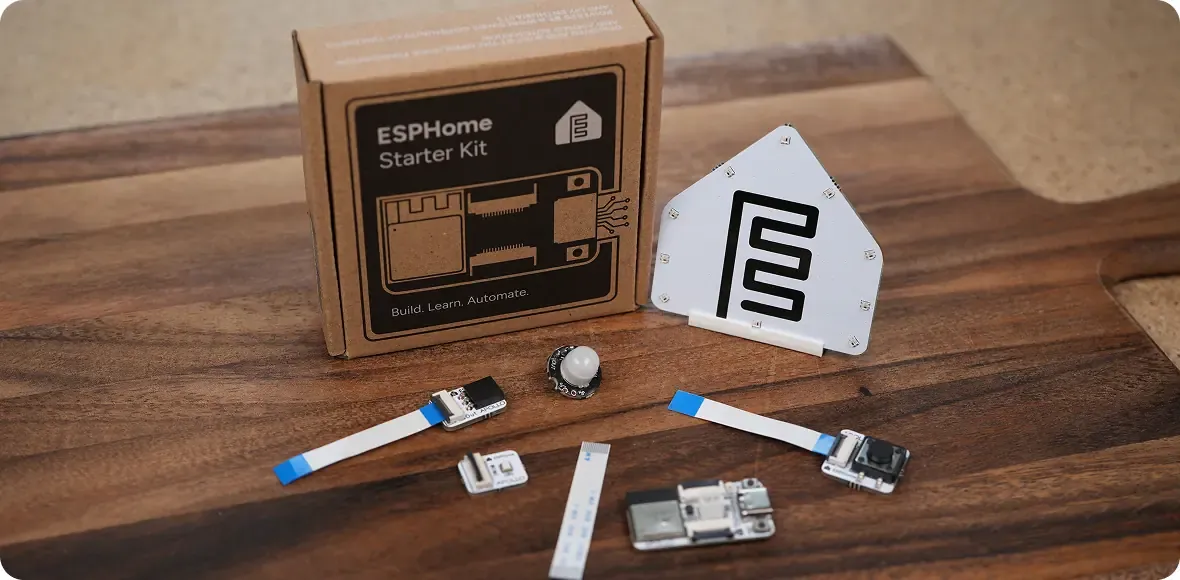
The starter kit has all the quality components you need for a successful build, so you don't have to source them yourself. And to bring it all together, we’ve created two digital tools to guide you from the first connection to your first automation.
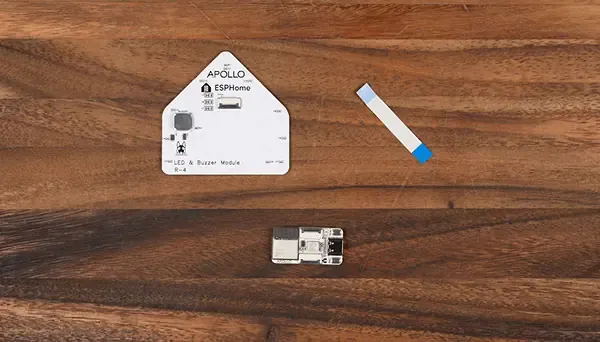
Easy assembly: Ribbon cable system.
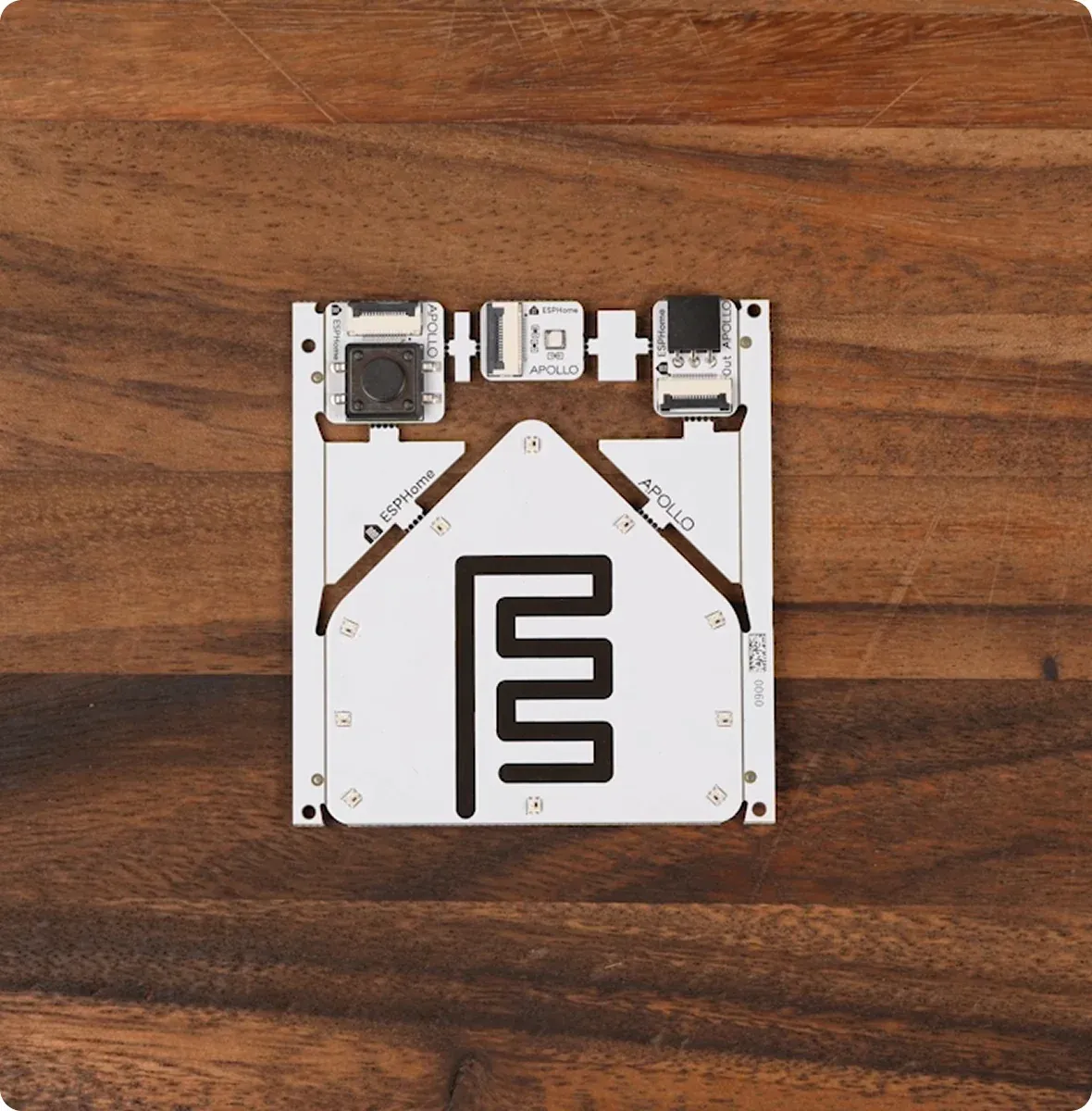
We've stripped back the complexity so you can focus entirely on learning: simply snap the modules off the panel and connect to the compute board via a single ribbon cable. No wiring, pins, soldering, or risk of getting it wrong!
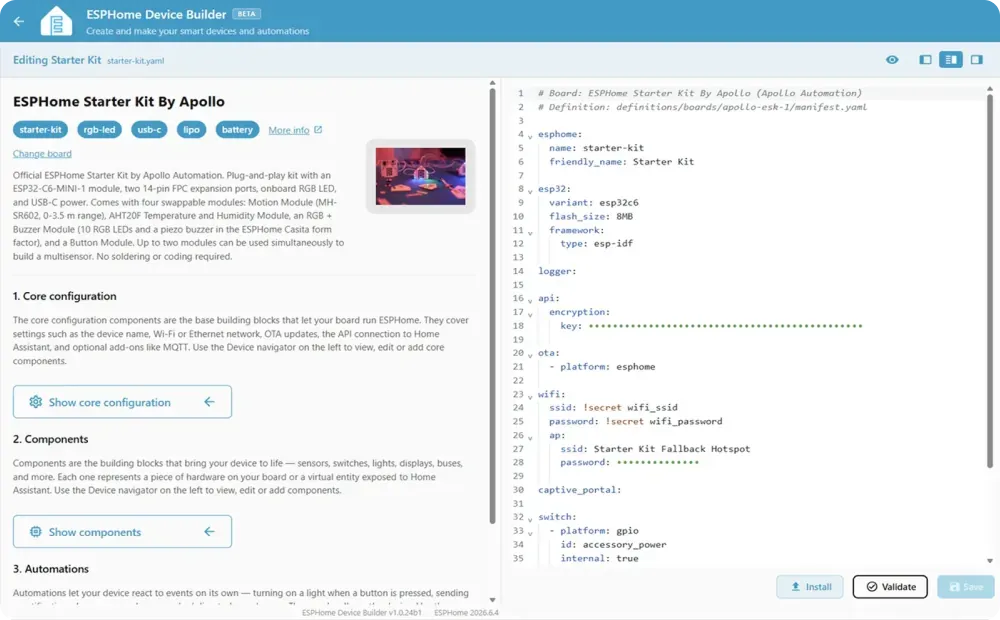
Coding optional:
Visual device builder
Intuitive interface lets you configure hardware and software without writing code – but the YAML's always there underneath, should you want it! Runs on your desktop via our app, or on your existing smart home setup.
Guided support:
Learning Wiki
More than just assembly instructions, our Wiki explains the “why” behind each action. It shows how your components connect to the code running them, giving you the skills to take on bigger projects when you're ready.
Explore what’s possible
These are just four of the things you can build with the ESPHome Starter Kit. Each pairs one of the kit's modules with an automation. Every module becomes a real, working smart home device – and once you've learned the basics, what you do next is entirely up to you.
Manual trigger
Tap the button module to set off any Home Assistant automation you choose: wake up to your favourite song, turn on the lights, or start the coffee machine.
Motion detector
Step past your motion sensor in a darkened room and your lights come on automatically: no fumbling for switches or an app.
Thermostat
Set a minimum temperature so your heaters warm up automatically if your bedroom gets too cold.
Event notification
Program LEDs to turn red and a chime to sound so you don’t forget to put out the trash or take your medicine.
These are a few starting points. The possibilities are endless. Combine the modules however you like, then take what you learn and build something new. See more in the Wiki →
Build with the community
Say hello to a welcoming community of makers already designing their own smart home devices, sharing configurations, and remixing the kit into projects of their own.
Explore projects
The latest community-designed 3D-printed enclosures, stands and mounts for every module: all ready to print and remix.
Join our Discord
Discuss anything ESPHome-related and connect with other makers – and show off your new creations, of course!
Community Forum
A great place for beginners to ask questions about the ESPHome Starter Kit, with helpful links to Learning Wiki and documentation.
Every purchase supports the Open Home
Apollo Automation designs and builds official ESPHome hardware. As a commercial partner of the Open Home Foundation, Apollo contributes the majority of its profits to the foundation. This means every purchase supports the development of projects like ESPHome and Home Assistant.
$40/41€*
*Recommended MSRP. Prices differ between regions due to varying local market costs and conditions, and subject to individual retailers.
A kit that has everyone talking
Discover what reviewers and community members are saying about the ESPHome Starter Kit.
“The best entry point the ecosystem has ever offered.”
 Valentin Goudet, Howmation

“It’s been absolutely fantastic playing with this new ESPHome device, it makes it just so simple.”
Simon Says Home Assistant

“Thanks to a visual editor, no actual programming or manual coding is required.”
 Notebookcheck
“This was really fun to try out! I can’t wait to build more with ESPHome.”
Reed, SmartHomeSolver
“The kit removes much of the hardware guesswork...”
 Ward Zhou, Matter Alpha
“Definitely if you haven’t messed with ESPHome this is a good place for you to start.”
digiblur DIY


Specifications
The ESPHome Starter Kit uses the same high-performance parts found in professional smart home devices, ensuring what you build today stays in your home for years to come.
Product details
Main board
- Espressif ESP32-C6-MINI-1
- Operating temperature: -40 °C to +85 °C
Power and data
- USB-C, 5 V DC
- Optional power: rechargeable LiPo battery (sold separately)
Connectivity
- Wi-Fi, Bluetooth LE, Thread
- Zigbee possible at the chip level for advanced users
Module ports
- 2 × 14-pin FPC
Onboard indicators
- RGB status LED
Configuration software
- ESPHome Desktop (free download for Mac, Windows, Linux)
- ESPHome add-on for Home Assistant
Module specifications
Each module connects to the main board with a 14-pin FPC ribbon cable. Two modules can run on the main board at the same time.
PIR motion sensor
- MH-SR602, up to 3.5 m detection range
- Operating temperature: -20 °C to +80 °C
Temperature & humidity
- AHT20F (±0.3 °C, ±2% RH)
- Operating temperature: -40 °C to +85 °C
Button
- Tactile pushbutton
- Operating temperature: -25 °C to +85 °C (typical)
Notification module
- ESPHome “Casita” board: 10 × programmable RGB LEDs and piezo buzzer
- Operating temperature: -20 °C to +70 °C (typical for LEDs and piezo)
Stand
- Included
Ribbon cables
- 3 × FPC (flexible printed circuit)
- Operating temperature: -40 °C to +85 °C (typical)
Environmental conditions for operation
Operating environment
- Indoor use only
- -20 °C to +70 °C
- -4 °F to +158 °F
- Humidity: non-condensing
- (Overall range bound by the narrowest component: the Casita module’s RGB LEDs and piezo buzzer)
Storage and care
- Keep in a dry, not excessively dusty environment to avoid damage to the unit.
- Do not leave the unit in direct sunlight or near any heat source, as this can cause overheating.
Device characteristics
Dimensions
- Main board: 35 × 18 × 10 mm
- Module board: 82 × 74 × 10 mm
In the box
- ESPHome ESP32-C6 main board
- ESPHome Starter Kit module board (temperature and humidity sensor, button, and ESPHome “Casita” notification modules)
- PIR motion sensor
- Stand
- 3 × FPC ribbon cables
Material
- PCB-based open design
Any questions?
What is ESPHome?
ESPHome is a free, open source platform that allows you to program small computer chips (called microcontrollers) to create your own custom smart home devices. Configure them through a simple visual interface – no complex coding required – and run locally in your home, so none of your data is sent to external servers or the cloud.
What sets the ESPHome Starter Kit apart from other electronics kits?
The ESPHome Starter Kit is purpose-built for creating smart home devices, rather than general electronics. It's solder and sourcing-free, so you can focus entirely on building and learning rather than wrestling with components. Paired with the ESPHome Device Builder and a Learning Wiki, it gives you a direct entry into the wider ESPHome ecosystem and everything it has to offer. And unlike most learning kits, the modules don't end up in a drawer when you're done: they become real, working smart home devices you'll actually want to use and display in your home.
Is this kit suitable for complete beginners?
Absolutely. The ESPHome Starter Kit has been designed to remove the barriers that typically put beginners off: no soldering, component sourcing, or coding experience required. The kit contains everything you need for your first projects, with the step-by-step Wiki guiding you from scratch, so you can work at your own pace, dip in and out, and keep building your skills as your confidence grows.
From what age can you use the kit?
The ESPHome Starter Kit is suitable for teenagers and adults. While younger children may enjoy the hands-on assembly, the programming and configuration side requires a level of reading and technical comprehension that suits ages 13 and up. That said, it makes a great shared project for parents and children to tackle together.
What smart home platforms does the ESPHome Starter Kit work with?
Any smart home platform that supports ESPHome, including Home Assistant (see below). It also works as a completely standalone system over Wi-Fi: handy if you're not yet using a smart home platform, or want to try one out before committing.
Must I run Home Assistant to use this kit?
The ESPHome Desktop App runs as a free download on Mac, Windows, and Linux, so it's possible to build with the kit without installing Home Assistant or running a server: your devices will still work over Wi-Fi. That said, pairing the kit with Home Assistant unlocks the full potential of your devices, giving you powerful automation, dashboards, and control over your whole smart home from one central hub.
Can the kit run on battery power?
Yes. The main board is powered by USB-C, with support for an optional rechargeable LiPo battery (sold separately), so you can use it cable-free anywhere in your home if you need to.
Can I expand this kit with other sensors later on?
Yes, but you won't need to deal with messy wiring. The main compute board expands using the same flat ribbon cable system. Once you're ready to move past the starter kit modules, you can use the ribbon ports to plug in other compatible breakout boards and sensors directly. If you eventually want to design complex custom electronics with loose wires, the skills you learn here will translate to standard developer boards.
Can I ruin the hardware if I make a mistake?
No! A great thing about this setup is the code on the chips can be overwritten. If you write a broken configuration or something goes wrong, you can simply plug the board into your computer via USB and overwrite it with a fresh start.
What if I get stuck or have questions not covered here?
Don't worry, you're not building alone! The ESPHome community is incredibly active and welcoming. You can jump into our Discord server for real-time troubleshooting, browse the forum for detailed discussions, or dive into the Learning Wiki for step-by-step guides. No matter your skill level, there's always someone ready to help out.